


Rastafari Community Opens New Tabernacle Near Nairobi
A new tabernacle near Nairobi highlights the growth of Kenya’s Rastafari community, following recent legal recognition and rising interest among young people.
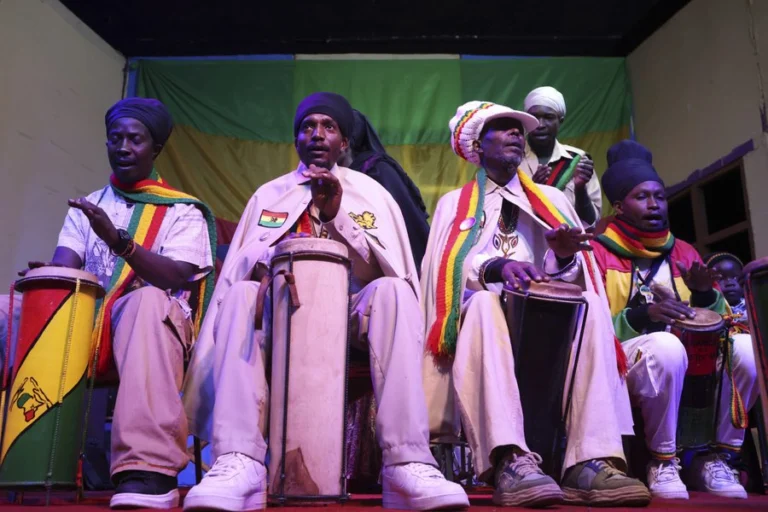
Rastafarians gather at the opening of a new tabernacle in Ruai, near Nairobi. Photo: @ThomasReeseSJ
August 21, 2025 Hour: 6:55 am
🔗 Comparte este artículo
A new Rastafari tabernacle has been inaugurated near Nairobi, signaling the growing recognition and visibility of a religious movement that recently secured legal protection in Kenya.
RELATED:
Kenyan Farmers Harness Nature to Reduce Human-Elephant Clashes
At least 30 Rastafarians gathered last month in Ruai, 25 kilometers east of Nairobi, to open a tabernacle constructed from wooden poles and iron sheets, decorated in the movement’s traditional red, yellow, and green colors. The ceremony included rhythmic singing, scripture readings, and discussions on Rastafari teachings and ways of life.
The event highlights the faith’s increased visibility following a 2019 High Court ruling, later upheld by the Supreme Court, that recognized Rastafari as a legitimate religion. The ruling addressed a case in which a student was expelled after refusing to cut her dreadlocks, a hairstyle integral to the practice of Rastafari.
Rastafari originated in 1930 with the coronation of Ras Tafari Mekonnen as Emperor Haile Selassie I of Ethiopia. Followers regard Selassie as the final incarnation of the biblical Jesus and see Ethiopia as a symbol of resistance to colonization. Although Selassie was overthrown in 1974 and died a year later, the movement continues globally, with communities in countries including the United States and Ghana.
In Kenya, Rastafari is organized into three “mansions”—Nyabinghi, Bobo Ashanti, and The Twelve Tribes of Israel—small groups that meet for worship in simple tabernacles rather than permanent structures.
Though the community remains small in a nation dominated by Christianity and Islam, it is growing, particularly among younger Kenyans. Ng’ang’a Njuguna, an elder of the Nyabinghi mansion, described Rastafari as “a spiritual way of life. That is why we connect with nature, we connect with animals, we connect with every living being because Rastafari is all about the spiritual world.”
For many converts, embracing Rastafari represents a break from colonial-era religious influences. Fedrick Wangai, 26, who converted six years ago, described his shift as “emancipation from Western religion.” He said, “I grew up in a Christian setup and I ended up questioning the faith because it was made by the white man who was the colonial master of my forefathers.”
Older members recall earlier experiences of discrimination. Christine Wanjiru, who became a Rastafarian in 1994, said, “Back then, there was a lot of stigma and discrimination against Rastafari. Most people never saw Rastafari as a good thing or a spiritual thing, from family members to the government, the police, all round. But we endured and we are here today.” She added that more people have since embraced the faith: “More brethren have received this light and have come to Rastafari.”
Njuguna noted that young Kenyans are drawn to the movement’s lifestyle. “They have that fire, they like how Rasta people carry themselves, how Rasta people live,” he said. “Our diet, art and skills.”
The inauguration of the Ruai tabernacle underscores the resilience and growing appeal of Rastafari in Kenya, where legal recognition and youth interest are helping the faith expand.
Author: MK
Source: AP